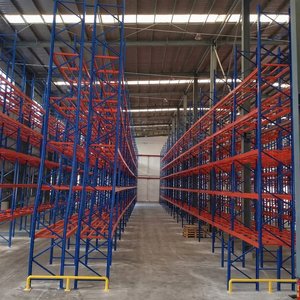
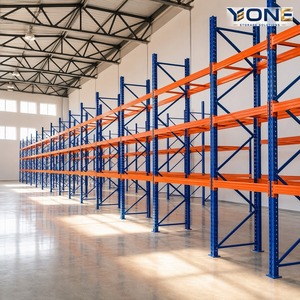
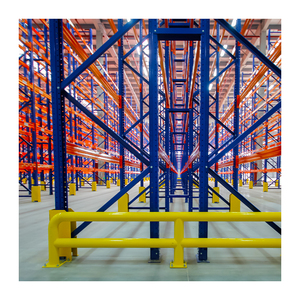
Mracking Heavy Duty Industrial Palletized Racking (1000–4000kg Capacity)
- Material Spec: Certified Q235B Steel
- Beam Section: Closed Box Profile
- Pitch Adjustability: 50mm / 75mm Pitch
- Standard Pallet: 48″ × 40″ GMA & Euro
Manufactured using high-tensile certified Q235B and Q355B structural steel, our storage systems deliver verified load ratings, precision tolerances for robotic automated handling, and durable surface treatments for cold-chain and dry distribution hubs worldwide.
Selecting the ideal racking architecture requires balancing floor space utilization against inventory velocity and handling machinery capital expense. Evaluate core system parameters below before finalizing facility layouts.
| Storage System Type | Direct Selectivity | Floor Footprint Utilization | Inventory Rotation | Handling Equipment Required | Relative Capex Index | Optimal Industry Application |
|---|---|---|---|---|---|---|
| Selective Pallet Racking | 100% (Instant) | 40% – 50% Space Utilization | FIFO or LIFO | Counterbalance / Reach Truck | Baseline (1.0x) | FMCG, 3PL logistics, high-SKU distribution |
| Very Narrow Aisle (VNA) | 100% (Instant) | 65% – 75% Space Utilization | FIFO or LIFO | Turret Truck / Man-Up Order Picker | Moderate (1.4x) | High-bay warehouses, expensive urban square footage |
| Double-Deep Racking | 50% Direct | 60% – 68% Space Utilization | LIFO Priority | Deep-Reach Pantograph Forklift | Economical (1.15x) | Manufacturing buffers, multi-pallet per SKU |
| Drive-In / Drive-Through | Per Lane Only | 75% – 85% Space Utilization | LIFO (Drive-In) / FIFO | Standard Counterbalance Forklift | Low-Medium (1.2x) | Cold storage, seasonal inventory, uniform batches |
| Mobile Pallet Racking | 100% (1-Aisle) | 85% – 90% Space Utilization | FIFO or LIFO | Standard Reach / Forklift | High (2.2x) | Deep freeze (-25°C), pharmaceutical cold-chain |
| Pallet Flow (Gravity Roller) | Per Lane Flow | 70% – 80% Space Utilization | Strict FIFO | Standard Forklift | High (2.0x) | Perishable food, expiration date-coded items |
| Radio Pallet Shuttle | Semi-Automated | 80% – 90% Space Utilization | FIFO & LIFO Flexible | Standard Lift + Battery Shuttle | Advanced (2.5x) | Beverage distribution, high-throughput batching |
| AS/RS Clad-Rack Silo | 100% Automated | 90% – 95% Space Utilization | WMS Dynamic Control | Automated Stacker Crane / Shuttles | Capital System (4.0x+) | Mega fulfillment hubs, lights-out automated plants |
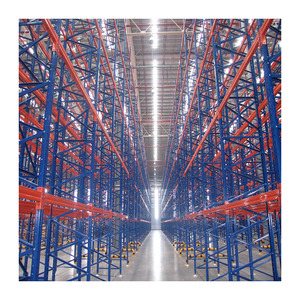
Combining ultra-large scale roll-forming capacity with finite element structural research partnerships, our manufacturing ecosystem provides verifiable load ratings, rigorous steel traceability, and seismic safety for mission-critical warehouse facilities.
Equipped with high-speed automated roll-forming lines, automated laser-punching presses, and robotic welding cells producing over 100,000 metric tons annually with continuous in-line dimensional scanning.
Components undergo physical strain testing at dedicated academic test facilities (including joint research with Mondragon University and UPV/EHU) ensuring exact compliance with EN 15512 and ANSI MH16.1.
Certified under ISO 9001, ISO 14001, ISO 45001, ISO 50001, ISO 3834-2, and EN 1090-1 (CE Mark). Every upright and beam carries laser-etched heat codes for lifecycle batch tracking and audit safety.
End-to-end accountability from initial layout simulation to container loading optimization and field assembly supervision. Backed by an industry-leading 5-Year Quality Warranty for all structural steel components.
As logistics hubs scale upward and autonomous material handling accelerates, procurement teams must look beyond raw steel weight. Modern procurement strategies prioritize structural integration, automation tolerances, and carbon accounting.
Autonomous Mobile Robots (AMRs) and stacker cranes cannot tolerate traditional manual rack deflection. Future procurement specifications mandate tight dimensional tolerances of ±1.0mm per 10m height, with laser-guided hole punching to ensure smooth robotic travel without sensor tripping.
With supply chain hubs expanding in seismically active corridors across the Americas and Asia-Pacific, procurement documents now enforce site-specific non-linear response history analysis. Uprights feature enhanced ductile cold-forming geometry and anchored oversized baseplates.
Civil building costs are driving developers toward rack-supported structures where the racking frames carry the outer wall panels and roof. This architecture reduces construction timelines by 25% to 35% while maximizing vertical volume up to 45 meters clear height.
Surging grocery delivery and pharmaceutical distribution demand high-density mobile and shuttle racking operating at -25°C to -30°C. Structural steel grades must guarantee Charpy V-notch impact toughness to prevent low-temperature ductile-to-brittle transitions.
Global enterprise buyers now audit Scope 1, 2, and 3 embodied emissions. China's top racking exporters are integrating electric arc furnace (EAF) low-carbon steel, closed-loop zero-discharge powder coating lines, and third-party ISO 14064 verified carbon reporting.
Shorter e-commerce product lifecycles require rapid rack reconfiguration without structural welding. Standardized connector clips, universal teardrop / diamond punch patterns, and toolless beam repositioning represent decisive criteria in 2025–2030 equipment tenders.
Unlike standard commercial steel, our storage systems utilize certified structural hot-rolled strip steel with continuous micro-alloying elements (vanadium and niobium) to optimize yield strength and post-buckling performance under eccentric live loading.
Every upright profile is cold-roll formed through 18 to 22 precision roll passes, creating a multi-flanged Omega section that maximizes sectional second moment of area (Ix and Iy) while minimizing material weight and transport costs.
Racking structural calculations adhere to international limits governing safe beam sagging under continuous maximum allowable load:
Clear engineering answers to critical inquiries regarding compliance, international shipping, cold chain operation, and automated AS/RS compatibility.
Every export project is modeled using finite element software calculated to the exact design codes of the installation territory: RMI ANSI MH16.1 and IBC in the USA/Canada, EN 15512 and EN 1090-1 (CE Mark) in Europe, and AS 4084 in Australia. Calculations undergo peer engineering review before fabrication commences.
Yes. We routinely engineer frame depths (typically 42″ or 44″) and clear beam spans (typically 96″, 108″, or 144″) specifically customized for the 48″ × 40″ GMA standard, EUR-pallets (1200×800mm), industrial ISO pallets (1200×1000mm), and custom plastic or metal skid runners.
For low-temperature applications, we specify killed, fine-grained structural steel tested for minimum impact energy absorption at sub-zero temperatures (Charpy V-notch tested). This prevents cold-shortness and brittle fracture failures, paired with high-adhesion ductile powder or hot-dip galvanized coatings.
In standard warehouses, racking stands inside an existing building envelope. In a rack-supported warehouse, the racking itself is the primary structural skeleton that supports the outer insulated wall cladding and roof, resisting dynamic external wind, snow, and seismic forces without dedicated concrete or steel building columns.
Beams and upright frames are bundled with protective corrugated paper corner buffers, heavy-gauge plastic wrapping, and high-tensile steel strapping. Container loading layouts are calculated using 3D stuffing software to balance axle loads, eliminate transit shifting, and facilitate quick forklift unloading at destination ports.
Shipments include Mill Test Certificates (EN 10204 3.1) showing chemical composition and mechanical yield testing, Certificate of Origin, detailed assembly layout drawings, structural engineering load rating capacity charts, and QA coating thickness inspection logs.
Connect directly with our structural engineering department. Provide your facility parameters, load dimensions, and throughput goals to receive preliminary CAD layout drawings, structural load calculations, and competitive FOB/CIF project estimates.
Download full structural component profiles, beam load tables, and case study engineering schematics.
Get CatalogInstant digital dispatch via global engineering support desk.