Featured Industrial Storage Systems & Heavy-Duty Racks
Designed, roll-formed, and certified for global warehouse operators, 3PL logistics facilities, distribution hubs, and industrial manufacturing plants.
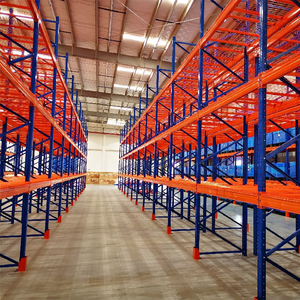
High Strength Metal Load Frame Industrial Large Goods Organizing Metal Warehouse Rack
- Steel Specification: Q355B / High Tensile
- Bay Load Capacity: Up to 24,000 kg
- Deflection Benchmark: L / 250 Strict Standard
- Surface Coating: Thermo-set Epoxy Powder
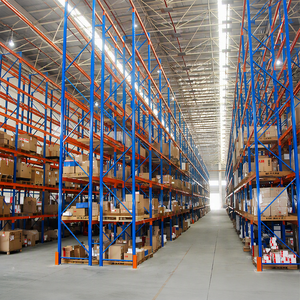
ODM OEM Industrial Adjustable Warehouse Heavy Duty Selective Pallet Racking Shelving System Manufacturer Shelf Rack Warehouse
- Beam Pitch Pitching: 50mm / 75mm Increments
- Beam Connection: 4-5 Claw Safety Hook
- Selectivity Ratio: 100% Direct Pallet Pick
- Manufacture Precision: Automated CNC Punching
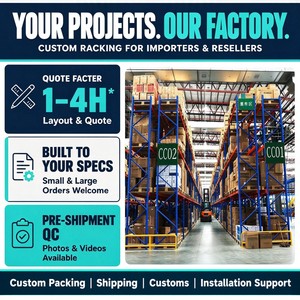
Warehouse Pallet Shelving Rack Selective Racking Layout Heavy Duty Steel Storage Design
- Pallet Profile Match: GMA 48x40" & Euro 1200x800
- Structural Uprights: Omega Cold-Formed Rib
- Compliance Marks: RMI MH16.1 & EN 15512
- Safety Components: Column Protectors & Mesh
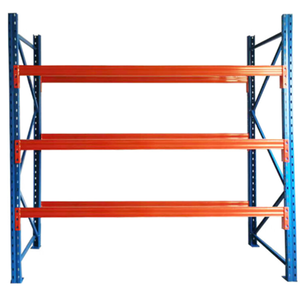
Mracking Industrial Warehouse Pallet Racking Shelving System
- Application Base: Multi-Tier Mezzanine / Bay
- Perforation Type: Diamond / Teardrop Hole
- Torsional Rigidity: High-Stiffness Cold Box
- Export Standard: Sea-Freight Palletized Bundle
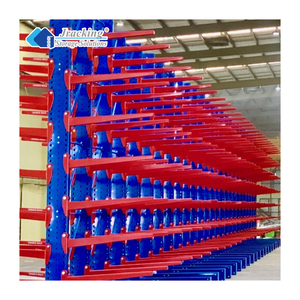
CE-Certified Industrial Warehouse Storage Shelves Heavy-Duty Cantilever Racking System for Cold Storage Pipe Storage
- Profile Material: Hot-Rolled IPE Beams
- Temp Resilience: -30°C Cryogenic Cold Rooms
- Application Load: Pipes, Structural Lumber, Coils
- Certification: CE Marking (EN 1090-1)
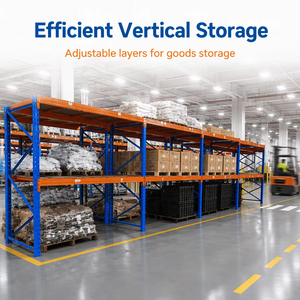
OEM ODM Adjustable Industrial Warehouse Storage Heavy Duty Selective Pallet Racking Shelving System Shelf Rack Manufacturer
- Custom Clear Span: Up to 4,500 mm Beams
- Safety Lock: Auto-Engaging Spring Pins
- Welding Standard: ISO 3834-2 Robotic GMAW
- Corrosion Proof: ASTM B117 500-hr Salt Spray
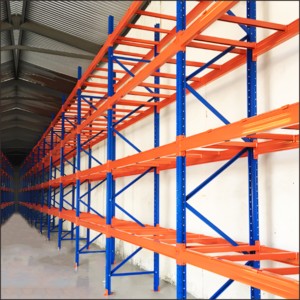
Heavy Duty Store Shop Display Shelving Tiers Garage Racking Shelves Steel Warehouse Shelf Metal Storage Rack Shelves Storage
- Shelf Decking: Drop-in Galvanized / Wire Deck
- Manual Picking: Up to 1,000 kg / Shelf Level
- Assembly Mechanism: 100% Boltless Wedge Lock
- Application Base: E-Commerce, Automotive Parts
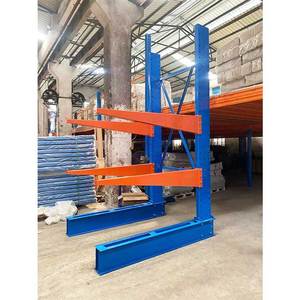
Heavy Duty Storage Cantilever Shelving Cyclocross Frame Cantilever Storage Storage Steel Industrial Hanging Cantilever Rack
- Column Layout: Unilateral & Bilateral Towers
- Arm Design: Tapered Pivot Impact Arm
- Base Anchoring: Chemical Anchor Epoxy M20/M24
- Longitudinal Bracing: High-Tension X-Brace Towers
The Paradigm Shift: From Generic Fabricators to Certified Structural Engineering Partners
Global industrial logistics has outgrown the era of sourcing commercial storage racks as basic steel commodities. In modern high-bay facilities reaching clear heights beyond 15 to 40 meters, storage racks function not as passive furniture, but as primary structural load-bearing skeletons subjected to extreme dynamic stress, seismic displacement vectors, harmonic crane vibration, and aggressive material handling impact.
Sourcing industrial storage systems from premier Chinese manufacturers and wholesalers now centers on verifiable engineering rigor. Leading Chinese production facilities, epitomized by advanced technological hubs with over 35,000 m² of footprint, have moved completely beyond manual workshop cutting. Modern tier-one manufacturing integrates fully automated roll-forming lines, laser-guided punch systems, robotic continuous seam welders (ISO 3834-2 compliant), and structural simulation laboratories operated in conjunction with leading polytechnic universities. For global distributors, wholesale supply chain integrators, and Fortune 500 brands, purchasing directly from verified Chinese industrial rack manufacturers delivers an optimized Total Cost of Ownership (TCO) combined with full regulatory compliance across North American RMI (Rack Manufacturers Institute) and European EN standards.
Racking Architecture & System Selection Matrix
Evaluate key operational variables, storage density factors, handling mechanics, and investment intensity across primary industrial racking topologies.
| Racking System Classification | Pallet Accessibility & Flow | Volumetric Space Density | Floor Footprint Utilization | Handling Equipment Required | Primary Industrial Use-Case |
|---|---|---|---|---|---|
| Selective Pallet Racking | 100% Direct Access (FIFO/LIFO) | Standard (40-50%) | Baseline Aisle Index | Standard Counterbalance, Reach Truck | High-SKU 3PL, FMCG, General Merchandising |
| Very Narrow Aisle (VNA) | 100% Direct Access (FIFO) | High (70-80%) | 1.6m - 1.9m Narrow Aisles | Turret Trucks, Man-Up Articulated Lifters | High-Bay E-Commerce Hubs, Expensive Real Estate |
| Double-Deep Pallet Racks | 50% Direct Access (LIFO) | Medium-High (60-65%) | Reduced Aisle Ratio | Deep-Reach Pantograph Forklifts | Manufacturing Staging, Multiple Pallets per SKU |
| Drive-In / Drive-Through | Lane Dependent (LIFO / FIFO) | Very High (75-85%) | Zero Operating Aisles | Counterbalance Driving into Racks | Cold Storage, Homogeneous Bulk Goods, Beverages |
| Mobile Pallet Racking | 100% (Single Mobile Aisle) | Maximum (85-90%) | Motorized Floor Rail Footprint | Standard Reach & Forklift Trucks | Refrigerated / Freezer Rooms (-25°C), Chemical Banks |
| Pallet Shuttle (Radio Controlled) | Lane Selective (FIFO & LIFO) | Maximum (85-92%) | Ultra-Deep Channel Arrays | Standard Forklifts + Autonomous Shuttles | High-Throughput Distribution, Frozen Food Staging |
| AS/RS Automated High-Bay | Fully Automated Computer Control | Absolute Peak (>90%) | Vertical Clears up to 45m | Stacker Cranes, Vertical Hoists, AGVs | Smart Megawarehouses, Pharmaceutical Cold Chain |
| Heavy-Duty Cantilever | Continuous Unobstructed Face | Custom Variable | Open Aisle Column Architecture | Side Loaders, Multi-Directional Lifters | Structural Steel Beams, Timber, Aluminum Extrusions |
Future Procurement Trends in Industrial Storage Racking
How technological automation, structural robotics, dynamic energy efficiency, and stringent carbon metrics are reshaping wholesale procurement criteria through 2030.
1. Millimeter-Level AS/RS & AMR Tolerances
With the rapid acceleration of Autonomous Mobile Robots (AMRs) and automated stacker cranes, wholesale racking buyers no longer accept conventional fabrication tolerances. Modern cold-rolled profiles demand laser-verified hole punch accuracy within ±0.5mm across an 11-meter upright span. Deflection limits have tightened from standard L/200 thresholds to robotic-grade L/300 or L/400 to prevent automated optical sensor tripping, driving purchasers to certified robotic production lines.
2. Clad-Rack & Rack-Supported Warehouse Architecture
Industrial civil construction costs continue to surge globally. Consequently, wholesale procurement is pivoting dramatically toward rack-supported buildings (clad-rack structures). In these civil-engineering marvels, the steel storage rack skeleton directly supports the external roof trusses, wall sandwich cladding, and internal refrigeration piping, drastically reducing civil foundation schedules, optimizing land tax zoning, and enabling high-density vertical hubs over 40 meters.
3. Cryogenic Steel Metallurgy for Cold Chain
The global expansion of biopharmaceuticals, vaccine hubs, and frozen food supply chains requires racking that withstands deep cryogenic operation down to -30°C without risk of catastrophic brittle fracture. Modern procurement guidelines enforce high-resilience modified silicon-manganese steels, impact-resistant beam connector geometry, and specialized polyester-epoxy powders resistant to micro-fissure condensation cycles.
4. Carbon Accounting & Traceability 4.0
Driven by EU CBAM (Carbon Border Adjustment Mechanism) and ESG reporting mandates across North America, enterprise buyers now require ISO 14064 verified greenhouse gas declarations for every metric ton of manufactured steel. Furthermore, Traceability 4.0 individual component barcoding enables logistics engineers to verify steel coil heat numbers, robotic welding cell batch records, and galvanization thickness from a simple QR scan on the rack column.
Scale, Engineering Integrity & Proven Reliability
Backed by over three decades of international manufacturing heritage, continuous academic R&D partnership, and robotic fabrication precision.
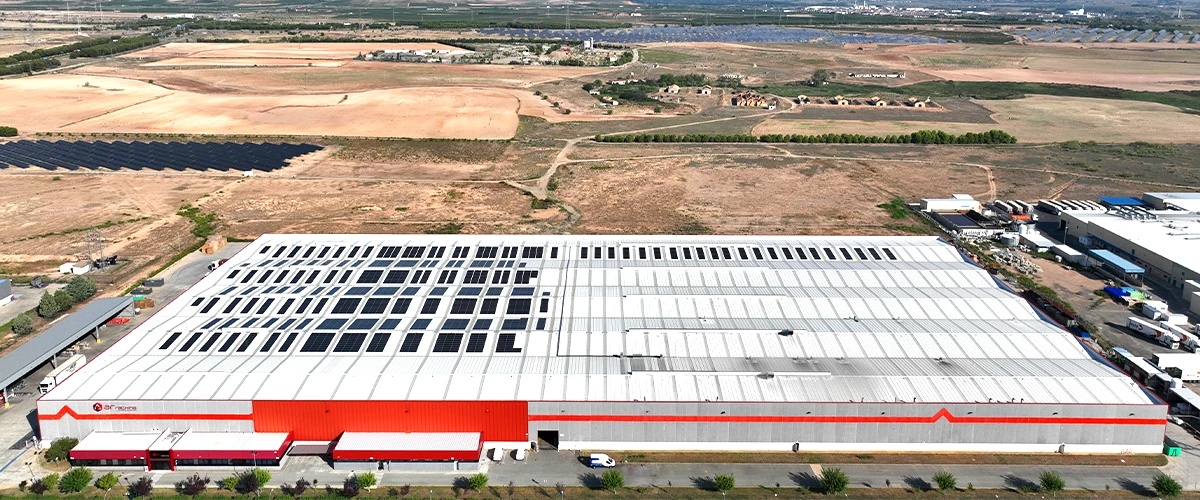
Advanced 35,000+ m² Automated Production Plant
Our manufacturing ecosystem integrates 100% automated roll-forming profiling lines capable of continuous high-speed punch and bend cycles without structural micro-fracturing. Operating with a massive yearly output exceeding 100,000 metric tons of structural cold-formed steel profiles, we guarantee predictable lead times for mega-distribution hubs spanning up to 200,000 pallet positions.
- Certified Metallurgy: Prime grade coil feed (Q235B, Q355B, ASTM A1011 equivalent) with verified chemical analysis certificates.
- Robotic Seam Welding: Continuous shield-gas GMAW robotic cells certified to international ISO 3834-2 standards.
- Full Surface Protection: Automated 7-stage pre-treatment washing with zinc-phosphate conversion and epoxy powder cure.
Applied R&D: Academic Testing Labs & Finite Element Simulation
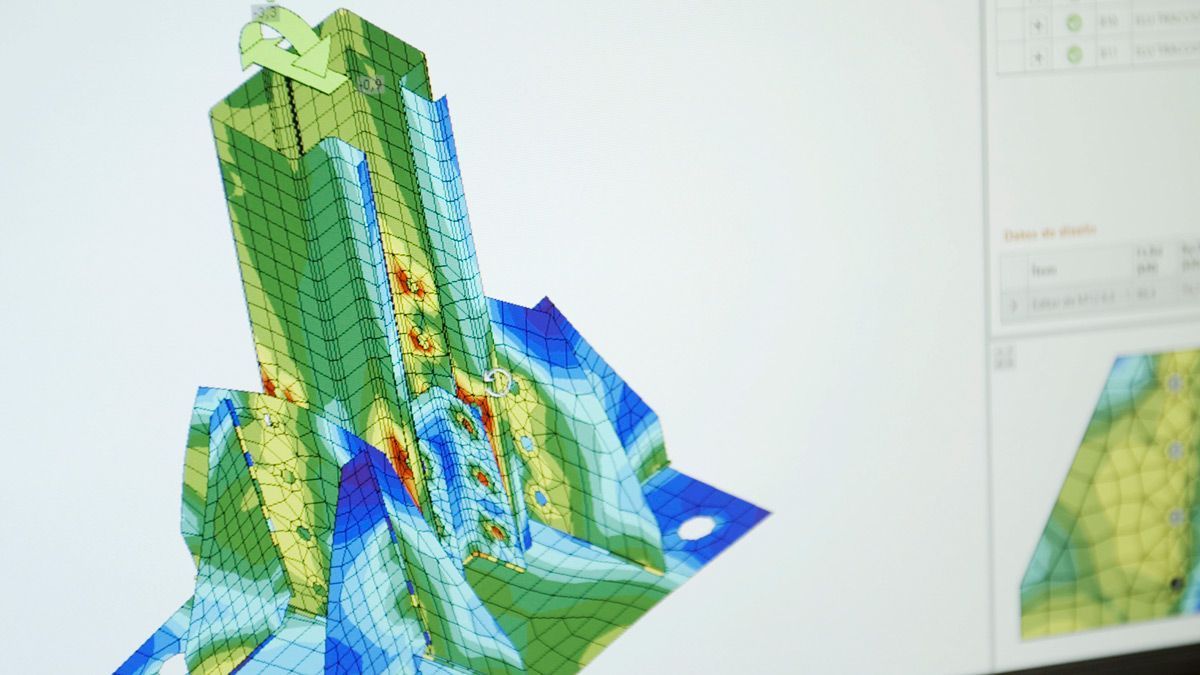
Racking integrity is never left to empirical guesswork. Through established research collaborations including the dedicated AR Lab with Mondragon University and the Research & Simulation Classroom at the University of the Basque Country (Bilbao School of Engineering), every upright geometry, connector shear lock, and baseplate anchor is subjected to continuous cyclic load testing.
Our in-house structural engineering department generates sophisticated non-linear Finite Element Analysis (FEA) models, verifying second-order P-Delta effects, buckling modes, and dynamic seismic responses compliant with both American RMI MH16.1 and European EN 15512 specifications.
- Full-scale physical stub-column and beam-end connector moment-rotation testing.
- Tailored seismic engineering coordination with local PE (Professional Engineer) stamps.
Audited Quality, Safety & Environmental Certifications
Wholesale procurement risk is mitigated through comprehensive, third-party accredited management and production audits.
ISO 9001:2015
Total Quality Management across roll-forming, punching, welding, and export packaging.
ISO 14001:2015
Comprehensive environmental control, zero hazardous discharge, and closed-loop water treatment.
ISO 45001:2018
Rigorous occupational health and workplace safety throughout heavy manufacturing lines.
ISO 50001:2018
Energy efficiency optimization and smart thermal recovery during steel powder baking.

ISO 3834-2
Comprehensive international quality criteria for fusion welding of metallic materials.

EN 1090-1: CE Mark
Conformity assessment of structural steel components and clad-rack building skeletons.

ISO 14064-1
Independently verified corporate greenhouse gas inventory and cradle-to-gate carbon metrics.
From Concept Layout to Load-Ready Handover
Eliminate interface friction, supply disruptions, and site installation bottlenecks through our proven 4-stage turnkey project model.
Civil Survey & Engineering Modeling
Complete architectural slab analysis, floor flatness evaluation (DIN 18202 / TR34), throughput simulation, and custom AutoCAD 3D / Revit BIM load profiling.
Automated Precision Production
High-speed continuous profiling on multi-roll rolling mills with laser-verified perforation geometry, robotic beam welding, and automated bundle palletization.
Global Export & On-Site Assembly
Export container utilization optimization, protective moisture-barrier sea packaging, and certified project engineering crews providing turnkey field assembly.
Load Sign-Off & 5-Year Warranty
Physical torque verification, laser plumb alignment audits, full structural load plate certification, backed by our comprehensive 5-year structural quality warranty.
Frequently Asked Questions by Industrial Racking Buyers
Technical answers to the structural calculations, material specifications, quality verifications, and logistics protocols asked by warehouse engineering directors.
What primary steel grades are used, and how do they correspond to Western standards?
Leading Chinese manufacturers strictly avoid scrap-recycled commercial iron and construct load-bearing uprights and beams using structural steel coils verified to national standards:
• Q235B: Yield strength $f_y \ge 235 \text{ MPa}$, equivalent to ASTM A36 / European S235JR. Used widely for standard picking shelving, light bracing, and secondary step decking.
• Q355B (formerly Q345B): High-tensile micro-alloyed structural steel with $f_y \ge 355 \text{ MPa}$, equivalent to ASTM A572 Grade 50 and European S355JR. Mandatory for heavy-duty upright frames, long-span load beams, and high-bay AS/RS systems where elastic deflection resistance is critical.
Every production heat is backed by genuine 3.1 Mill Test Certificates (MTC) documenting chemical spectrometry (C, Mn, Si, P, S) and Charpy V-notch impact toughness.
How do your structural engineers verify seismic resistance for North American and European codes?
Seismic compliance is not generic; it is calculated uniquely for each warehouse's geographic coordinates, seismic design category (SDC A through F), soil class, and building importance factor. Our technical engineering division utilizes specialized finite element structural modeling tools that interface seamlessly with:
• United States: ANSI/RMI MH16.1 (Specification for the Design, Testing and Utilization of Industrial Steel Storage Racks), ASCE 7 (Minimum Design Loads and Associated Criteria for Buildings), and the International Building Code (IBC).
• Europe: EN 15512 (Steel static storage systems - Adjustable pallet racking systems - Principles for structural design) and Eurocode 8 (Seismic design).
When required, we coordinate directly with registered local Professional Engineers (PE) to provide wet-stamped or digitally signed structural calculation dossiers for municipal building permit approval.
What deflection ratio limits do you design to for manual vs. automated warehouses?
Deflection limits govern safe clearance and operational reliability under full live load:
• Conventional Forklift Warehouses: Beam vertical deflection is governed by $L/200$ (where $L$ is the clear span distance). For a 2,700 mm beam pair, maximum deflection under maximum rated load is restricted to 13.5 mm without permanent plastic deformation.
• Automated AS/RS and Radio Shuttle Channels: Stricter structural performance thresholds of $L/300$ or $L/400$ are enforced. Automated crane positioning sensors, laser extractors, and robotic shuttles can misread pallet levels or suffer mechanical jamming if vertical or horizontal frame sway exceeds 2.0 mm to 3.0 mm.
How do you prevent brittle fracture and coating failure in cold storage (-25°C to -30°C)?
In cryogenic freezer environments, ordinary carbon steel can experience ductile-to-brittle transition, causing sudden catastrophic frame failure under accidental forklift impact. To eliminate this risk:
1. Impact-Tested Substrates: We utilize fine-grain structural steels with certified impact energy absorption (Charpy testing $\ge 27 \text{ Joules}$ at -20°C or -40°C).
2. Flexible Epoxy-Polyester Powder Formulations: Standard rigid coatings fracture during repetitive expansion-contraction cycles. Our cold-store powders incorporate cross-linking plasticizers that preserve elasticity and pass ASTM D3359 cross-hatch adhesion testing in sub-zero humidity.
What third-party quality inspections are permitted before ocean container dispatch?
We welcome and routinely facilitate pre-shipment inspections (PSI) conducted by internationally accredited testing bodies including SGS, Bureau Veritas (BV), TÜV SÜD, and Intertek. Typical Factory Acceptance Testing (FAT) protocols encompass:
• Ultrasonic weld flaw detection on beam connector heads.
• Dry film thickness (DFT) magnetic coating measurement (target: 60-90 μm).
• Dimensional verification of hole pitch, omega upright profile cross-sections, and column straightness ($\le 1.0 \text{ mm per } 1,000 \text{ mm}$).
• Packaging inspection to ensure steel bands, edge corner protectors, and heat-shrink polyethylene wraps prevent salt-air corrosion in maritime transit.
How do wholesale distributors optimize ocean container freight costs for large steel orders?
Structural steel racking is both dense and volumetrically demanding. To minimize landed freight costs per pallet position, our logistics software simulates 3D packing layouts in 40ft High Cube (40HQ) containers:
• Upright frames are nested or exported unbolted (knocked down) to allow up to 26–28 metric tons of steel per container without exceeding highway gross vehicle weight ratings.
• Box beams and step beams are bundled on customized steel pallets designed for easy slip-sheet or reach-fork offloading at destination ports, reducing offloading labor by over 60%.
What warranty terms and spare-part replacement lifecycles are guaranteed?
All primary structural racking components (columns, upright bracing, load beams, row spacers) carry our verified 5-Year Structural Quality Warranty against manufacturing defects, weld delamination, or abnormal powder coat degradation. In addition, through our Traceability 4.0 production records, original tooling dies and profile specifications are archived for a minimum of 15 years, guaranteeing wholesale clients access to identical replacement parts and expansion bays throughout the facility's lifecycle.
Ready to Engineer Your Warehouse Storage Infrastructure?
Connect directly with our structural engineering team. Whether you are budgeting an international logistics facility, retrofitting a high-bay automated warehouse, or seeking a certified OEM/ODM manufacturing partner in China, we deliver documented precision, structural compliance, and direct factory wholesale pricing.
- Receive initial 2D layout optimization and capacity calculations within 48 hours.
- Full project coordination compliant with RMI MH16.1, EN 15512, and local seismic codes.
Request Technical Proposal
Instant consultation with senior racking engineers & wholesale specialists.
Inquire Now