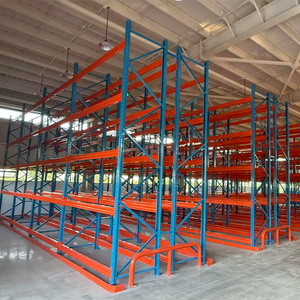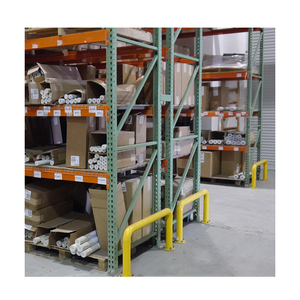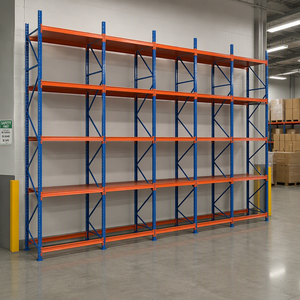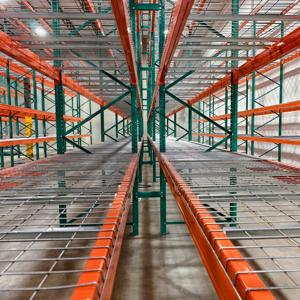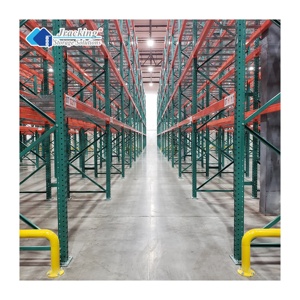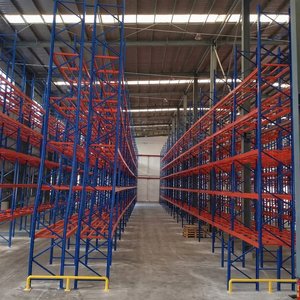
China Wholesale Beam Pallet Racking Manufacturer & Supplier

Precision-Engineered Heavy Duty Warehouse Storage Systems · Automated Production Capacity >100,000 Tons/Year · Certified to ISO 9001, EN 1090-1 & RMI Standards

5-Year Structural Warranty Direct Mill Certified Q235B / Q355B Steel Serving 60+ Global Markets
Direct Factory Catalog

High-Performance Beam Pallet Racking Systems

Engineered for standard GMA 48"×40" pallets, European Euro-pallets (1200×800mm), and heavy industrial loads. Certified deflection compliance (L/200, L/250, L/300) across all standard configurations.

42,000+
Worldwide Projects Executed
100,000t/yr
Automated Plant Capacity
60+
Export Destination Countries
35,000m²
Intelligent Manufacturing Base
Enterprise Manufacturing Authority

Engineered Reliability from Raw Coil to Load-Bearing Storage Matrix

As a leading Chinese wholesale manufacturer and global supplier of heavy-duty beam pallet racking systems, our engineering capability is built on empirical testing, academic structural research, and end-to-end robotics. In strategic collaboration with the AR Lab at Mondragon University and our Research & Simulation Classroom at the University of the Basque Country (Bilbao School of Engineering), we subject beam connectors, column uprights, and dynamic seismic baseplates to continuous physical load trials and finite-element modeling (FEA).

Our intelligent factory spans over 35,000 square meters, featuring 100% automated roll-forming lines, automated laser-guided punching stations, and continuous robotic welding cells. With Traceability 4.0, every single structural column, box beam, and bracing channel carries laser-marked production tracking, guaranteeing total metallurgical accountability across supply chains in North America, Europe, Southeast Asia, and Australasia.

ISO 9001 & ISO 14001 Quality & Environmental Audited
ISO 3834-2 & EN 1090-1 Certified Steel Structural CE Marking
RMI / ANSI MH16.1 Tested Teardrop Geometry Compliance
ISO 14064 Verified Certified Low Carbon Footprint Steel

Structural Integrity Metrics

Verified manufacturing tolerances strictly aligned with European FEM 10.2.02, Australian AS4084, and American RMI standards.

Steel Minimum Yield Strength (Q355B) ≥ 355 MPa (51.5 ksi)
Beam Deflection Allowable (Max Elastic) 1/200th Clear Span (L)
Upright Perforation Center Deviation ≤ ±0.5 mm / 10m
Powder Coating Film Adhesion (Cross-Hatch) Class 0 (ISO 2409)
Standard Factory Warranty Coverage 5-Year Complete Structural
Contact Us
Technical Evaluation Matrix

Engineering Comparison: Industrial Beam Racking Architectures

Selecting the optimal beam racking topology requires balancing selectivity, floor footprint density, seismic building codes, and handling velocity.

Racking Topology Direct Pallet Selectivity Storage Volume Density FIFO / LIFO Rotation Material Handling Equipment Typical Logistics Scenarios
Standard Selective Beam Rack 100% Immediate Access Moderate (35-40%) Both FIFO & LIFO Counterbalanced, Reach Truck Fast-moving retail distribution, high-SKU 3PL facilities, raw materials
Double-Deep Beam Racking 50% Immediate Access High (50-60%) Strictly LIFO Deep-Reach Pantograph Forklift Medium SKU consolidation, bulk pharmaceutical, dry grocery packaging
Very Narrow Aisle (VNA) Beam 100% Immediate Access Very High (65-75%) Both FIFO & LIFO Turret Truck, Wire-Guided Man-Up High-bay clearance warehouses (>12m), expensive real-estate hubs, e-commerce
Cold Storage Teardrop Beam 100% Immediate Access Custom Density Both FIFO & LIFO Heated-Cab Cold Store Trucks Freezer logistics (-25°C to -30°C), meat & dairy holding facilities
Push-Back Beam System Lane-Dependent (2-6 Deep) Maximum (75%+) Strictly LIFO Standard Counterbalanced High-turnover multi-pallet batch shipping, staging areas, staging buffer
Pallet Shuttle Beam Integration Lane-Dependent (Deep-Lane) Maximum (85%+) Configurable FIFO / LIFO Radio Shuttle Cart + Lift Truck Beverage bottling, high-volume seasonal inventory, cold storage distribution
Strategic Sourcing Insights

Future Procurement Trends in Heavy-Duty Beam Racking (2026–2030)

Global supply chain executives and wholesale procurement directors are adjusting vendor evaluation criteria around automation-readiness, seismic resilience, and total lifecycle carbon tracking.

01

High-Tensile Micro-Alloy Steels

Procurement is migrating from commercial-grade steel to high-yield Q355B and S355JR cold-rolled coils. Micro-alloyed structures decrease overall deadweight while boosting load-carrying moment resistance by 22%, saving intermodal freight costs per shipping container.

02

AS/RS & AMR Robotic Precision

Manual forklift operations are giving way to Autonomous Mobile Robots (AMRs) and automated stacker cranes. Wholesale buyers demand tight fabrication tolerances (±1.0mm) to prevent optical sensor misreads during high-speed robotic picking cycles.

03

Traceable Scope 3 Decarbonization

Tier-1 multinational enterprises (including retail and grocery leaders) require verifiable environmental disclosures. Sourcing managers now require ISO 14064 verified carbon tracking, dry-film eco-powder coating, and energy-optimized production lines.

04

Turnkey Seismic & Site Engineering

Wholesale clients are moving away from component-only purchasing. Sourcing agreements now mandate vendor-supplied finite-element calculation books certified to IBC (International Building Code), ASCE 7 seismic anchors, and Eurocode EN 15512 specifications.

R&D Innovation Roadmap

Technological Evolutions in Beam Pallet Racking Design

How cutting-edge structural engineering, advanced coating formulations, and digital twin monitoring are reshaping warehouse steel structures.

Advanced Beam Connector Kinetics

Traditional 2-claw or 3-claw connectors are being superseded by engineered 4-claw and 5-claw interlocking lug assemblies. Designed with an eccentric taper lock, these connectors translate pallet gravitational loads into lateral clamping force, drastically increasing frame torsional stiffness and moment resistance without beam rotation.

  • High shear capacity 4.8 / 8.8 grade safety lock pins
  • Zero-play engagement tested in university simulation labs
  • Resistant to accidental vertical forklift tines dislodgement

Sub-Zero Metallurgical Ductility

In low-temperature and blast-freezer warehouse operations (-25°C to -35°C), standard mild steels risk brittle fracture failure at welded joints. Advanced cold-store beam racking utilizes killed steel heats with controlled grain sizes and high Charpy V-notch impact values, ensuring uninterrupted yield strength under dynamic loading.

  • Charpy V-notch ≥ 27 Joules at -20°C verification
  • High-adhesion thermo-setting polyester powder barrier
  • Eliminates micro-cracking across beam-to-endplate welds

Digital Twin FEA & Sensor Embedding

By pairing structural modeling algorithms from our university simulation laboratories with on-site deflection sensors, warehouse operators can track frame health in real time. Dynamic load cells and optical strain gauges identify pallet overload conditions, seismic tremors, or forklift collision impacts before structural yielding occurs.

  • Finite element analysis (FEA) project verification
  • Millimeter-accurate column plumbness monitoring
  • Predictive maintenance data for annual safety recertification
Wholesale Procurement FAQ

Critical Questions Asked by Warehouse Engineers & Sourcing Directors

Technical, logistical, and structural answers to streamline your direct-from-manufacturer procurement evaluation.

What steel grades are used in your wholesale beam pallet racking, and can you provide mill test certificates?
We manufacture our upright columns and horizontal beams using prime structural coil grades Q235B and Q355B (equivalent to ASTM A36 and ASTM A572 Grade 50, or European S235JR and S355JR). Every batch of raw steel is sourced from audited tier-1 state-owned steel mills and undergoes spectral chemical analysis and tensile yield testing. Original 3.1 Mill Test Certificates (MTC) in accordance with EN 10204 are supplied with shipping documentation for every wholesale container order.
How does your factory engineer beam racking for high seismic zones (IBC / ASCE 7 / Eurocode 8)?
For seismic installations, our structural engineering team calculates baseplate surface area, concrete slab anchor embedment depths, and frame bracing shear profiles according to local seismic accelerations (Ss and S1 values). We increase column section gauges, incorporate heavy-duty ductile baseplates, and design high moment-resisting beam-to-column connections that absorb and dissipate ground shock waves without catenary failure or joint shear collapse.
What are the maximum load deflection allowances calculated for your standard box and step beams?
Our standard beam calculations strictly conform to the deflection limit of L/200 (where L is the clear span distance between upright columns) under uniformly distributed static loading (UDL), as mandated by ANSI MH16.1 and FEM 10.2.02. For automated AS/RS or shuttle-integrated warehouses requiring tighter tolerances, our engineers calculate heavier profile sections meeting L/250 or L/300 deflection criteria to prevent optical sensor interference.
Can your factory manufacture custom upright punching styles such as 2-inch teardrop for US clients?
Yes. We run dedicated automated roll-forming and CNC punching lines that produce standard North American 2-inch pitch teardrop patterns, compatible and interchangeable with major US teardrop systems. In addition, we supply European 50mm and 75mm pitch hex/diamond hole uprights, Australian AS4084 76.2mm pitch profiles, and custom OEM/ODM roll-formed sections based on client tooling requests.
What quality control procedures and surface finish standards prevent corrosion in humid or cold environments?
All fabricated steel components pass through a 7-stage automated chemical pre-treatment system, comprising high-pressure degreasing, zinc phosphate etching, and deionized water rinsing. Electrostatic polyester powder is automatically applied at 60 to 80 microns dry film thickness (DFT) and cured in a 200°C baking tunnel. This delivers over 500 hours of continuous salt-spray resistance (ASTM B117) and superior resistance to chipping from forklift operations. Hot-dip galvanized uprights and zinc-electroplated wire decks are also available for coastal or outdoor facilities.
What is the standard production lead time and container packing efficiency for bulk export shipments?
Standard factory production lead time is 3 to 4 weeks from signed engineering drawings for orders up to ten 40-foot High Cube (40HQ) containers. Our logistics packaging team optimizes container space using custom steel bundling cradles, protective plastic stretch wrapping, and corrugated edge guards. Upright frames are pre-assembled or flat-packed knocked-down (KD) to optimize cubic volume, allowing up to 22 to 25 metric tons of certified steel racking per 40HQ container.
Complete Lifecycle Support

From Structural Design Calculation to Global On-Site Commissioning

Eliminate project delays by partnering with a manufacturer providing verified engineering drawings, automated fabrication, and complete project oversight.

01

Engineering & Layout

3D CAD/BIM warehouse layout, seismic slab load simulation, and bill of materials calculation.

02

Robotic Production

Automated roll-forming, robotic welding, and powder coating backed by Traceability 4.0 barcoding.

03

Intermodal Shipping

Cradle bundling and ocean freight logistics to North American, European, and Australian ports.

04

Installation & Sign-off

Plumbness verification, anchor torque checking, and provision of a 5-year structural warranty.

Request an Engineered Racking Proposal & Factory-Direct Wholesale Quotation

Submit your warehouse layout drawings, pallet specifications (length × width × height × weight), and ceiling clear height. Our engineering team will supply preliminary CAD layouts and a certified cost matrix within 24 business hours.