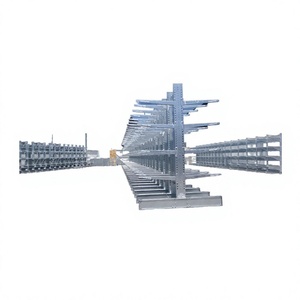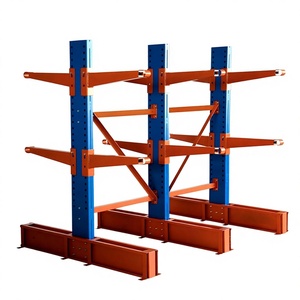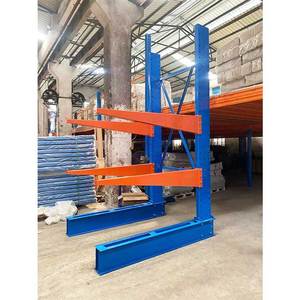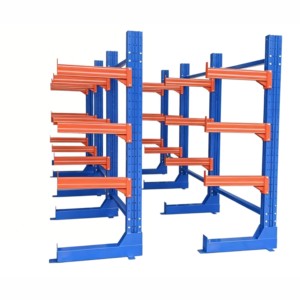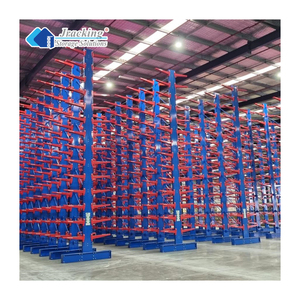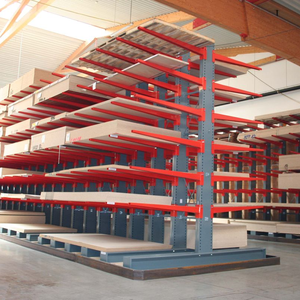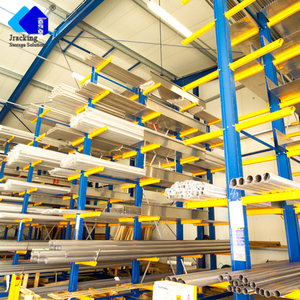
Jracking Q235B Steel Heavy Duty Cantilever Rack for Long Products
- Material: High-Yield Structural Q235B Steel
- Capacity: Up to 1,500 kg per arm load
- Application: Vehicle frame & bar profile stock
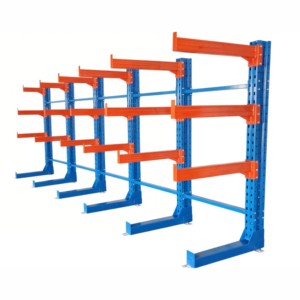
Manufactured by China's leading warehouse rack exporter, combining custom column profiles, CNC laser-punched pitch adjustments, and industrial corrosion resistance for demanding logistic operations.
Why leading global EPC contractors, 3PL distributors, and industrial plants trust our export supply chain: documented metallurgical traceability, university structural testing, and robotic production consistency.
Over 35,000 m² of modern manufacturing floor equipped with automated robotic continuous roll-forming lines, laser-guided punching stations, and synchronous welding units. Every upright and arm connector is manufactured with micro-millimeter tolerance, eliminating cumulative installation stresses and ensuring field bolt-hole alignment during high-bay assembly.
Continuous engineering innovation co-developed through academic testing laboratories and advanced structural simulation centers. Utilizing non-linear finite element structural simulation (FEA) and full-scale static arm deflection tests, our structural engineering team verifies physical load reactions against governing international standards (EN 15512, FEM 10.2.02, and ANSI/RMI MH16.1).
Every single batch of steel coil is sourced with certified raw material mill test certificates (MTC) conforming to EN 10204 3.1. From cold-roll forming to electro-static powder curing or hot-dip galvanizing, components receive unique laser tracking marks ensuring complete supply chain transparency, backed by a comprehensive 5-Year Structural Quality Warranty.
Global logistics demand is pivoting away from standard static rack purchases. Sourcing directors and warehouse planners must align procurement specifications with emerging economic and structural trends.
Supply chain shocks have accelerated the adoption of standardized European and American pitch hole patterns (such as 100mm, 140mm, and 4-inch increments). Global logistics operators increasingly require universal modularity so cantilever arms, guide rails, and bracing cross-members can be interchanged or relocated between distribution hubs across regional corridors without custom re-welding.
Global building codes (IBC 2024, Eurocode 3, and AS 4084) are tightening dynamic load safety coefficients. Procurement requests now mandate project-specific baseplate anchor calculations, ground motion spectral response accelerations (Ss, S1), and flexible cantilever arm pins designed to dissipate kinetic energy during seismic excitation rather than causing sudden structural column shear.
Procurement teams are shifting analysis from initial unit FOB price to 15-year Total Cost of Ownership (TCO). In open-yard lumber distribution, steel pipe stockyards, and coastal facilities, hot-dip galvanization conforming to ISO 1461 (with minimum 70–85 µm zinc layer thickness) has become the gold standard to eliminate recurrent corrosion blasting and painting downtime.
From automated guided vehicle interfaces to digital structural twins, cantilever systems are evolving from passive metal structures into intelligent, automation-compatible warehousing hubs.
Fully automated cantilever AS/RS systems utilizing robotic telescopic inserters or overhead stacker cranes. Designed to transfer 6-meter steel pipes and aluminum billets up to 25 meters in building height with continuous positional accuracy under ±2mm.
Application of Q355B and high-yield cold-rolled micro-alloyed structural steels. These alloys increase load-bearing capacities by 28% without increasing column self-weight, lowering foundational slab loading and transatlantic shipping container weights.
Elimination of conventional building structural skeletons. The cantilever upright columns themselves carry external roof trusses, insulated sandwich wall panels, and snow/wind loads, reducing overall capital building expenditure by up to 35%.
Smart strain gauges integrated into high-stress column-arm junction pins. Real-time telemetry notifies warehouse management systems (WMS) when dynamic fork impact or arm overloading exceeds allowable elastic deflection limits.
Essential technical, quality assurance, and logistic answers compiled by certified structural storage engineers for international procurement teams.
Collaborate directly with our senior racking design engineers. Send us your warehouse CAD layout, clear ceiling heights, and load bundle dimensions to receive an optimized structural proposal, seismic load verification, and competitive export pricing within 24 hours.