In 2026, choosing Pallet Racking is not simply a matter of fitting more pallets into a building. It means balancing load capacity, aisle width, picking speed, inventory rotation, and future automation. A selective rack may offer direct access to every pallet, while drive-in, push-back, and pallet-flow systems can increase storage density. Each choice changes how forklifts move and how quickly workers can reach the next load. Small design details matter: a few inches of clearance can affect turning space, and uneven loading can undermine a carefully planned layout.
The MHI and Deloitte 2024 Annual Industry Report found that 55% of surveyed supply-chain professionals planned to adopt robotics and automation within five years. That figure does not prescribe a rack type. It does show why warehouse layouts should account for changing equipment and workflows. A rack selected only for today’s forklift may become an obstacle when tomorrow’s operation adds automation. Measure the real loads. Check the actual aisle.
This guide compares the main racking types by density, accessibility, and operational fit. It also considers the details that are easy to overlook, including pallet condition, beam levels, and replenishment patterns. One sourcing note matters: no verifiable named Pallet Racking expert quotation was provided for this introduction, so I have not invented one. A published quote should be confirmed against its original source before publication.
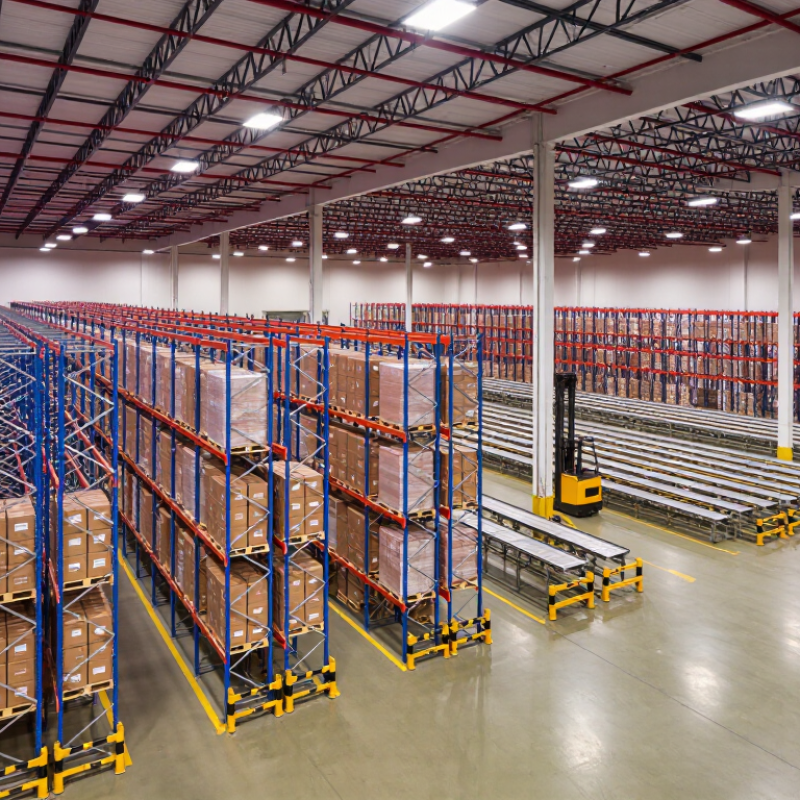
Pallet racking is a steel framework that stores palletized goods above the floor, using beams and upright frames to create selectable storage locations. A forklift places each pallet onto a beam level; the rack transfers its load through the frames to the floor. In practice, teams need to match rack design to pallet dimensions, product weight, handling equipment, and access needs. A rack that fits the building but blocks turning space can slow work. Small details matter.
The MHI and Deloitte 2024 Annual Industry Report found that 55% of surveyed organizations planned to invest more than $1 million in supply-chain innovation over the next two years. That investment may support warehouse technology, but it does not make a storage layout efficient by itself. Selective racks provide direct access to each pallet, while higher-density systems can reduce aisle space but limit access. Not automatically better. For example, a warehouse with many fast-moving product types may value quick access more than maximum pallet count. Before installation, teams should confirm floor capacity, clearances, sprinkler access, and load labels with qualified professionals. Even a careful plan can miss seasonal inventory changes. That deserves another look.
The best racking depends on what moves through the building, not on a single “best” system. Start with SKU count, pallet volume, order frequency, and the need to reach each pallet directly. Selective racks suit varied SKUs and frequent access, but consume more aisle space. Drive-in or push-back racks store more pallets per footprint, yet limit selectivity. That trade-off matters.
The U.S. Census Bureau reported that e-commerce accounted for 16.1% of U.S. retail sales in Q4 2024. Warehouses handling small, fast-moving orders may benefit from selective racks near picking areas, with denser storage for reserve stock. MHI’s 2024 Annual Industry Report found that 55% of surveyed supply-chain leaders planned to increase technology investment. That figure is not a rack specification. It does suggest planning for possible automation, including clear travel paths and compatible equipment.
Measure carefully. A narrow-aisle layout can add storage positions, but only if forklifts can operate safely within the aisle and floor conditions support the loads. Check pallet dimensions, rack beam capacity, ceiling height, sprinkler clearance, and future changes in inventory. For uniform, high-volume goods, drive-in racking may fit; for mixed products, it may create frustrating retrieval delays. I would not choose by density alone. A site review by a qualified rack professional can expose constraints that a warehouse sketch misses.
Selective pallet racking stores pallets on horizontal beams fixed between upright frames. A forklift can reach each pallet position directly, without moving another load first. That makes it a strong fit for warehouses carrying many SKUs with modest quantities of each. A common 48-by-40-inch pallet fits familiar layouts, but beam spacing and aisle width must match the actual loads and forklifts.
The trade-off is space. Wide forklift aisles and direct access reduce storage density compared with some high-density systems. In practice, teams often choose selective racks when picking speed and clear stock visibility matter more than storing the maximum number of pallets. The MHI 2024 Annual Industry Report found that 91% of surveyed supply-chain leaders expect digital supply chains to become the predominant model within five years. That is broader than rack selection, but it highlights why accurate location data and reliable inventory records matter even in a conventional rack layout.
Selective racks can support FIFO workflows, but the rack alone does not enforce rotation; slotting rules and handling practices do. Check the rack design against pallet dimensions, load weights, floor conditions, and forklift clearances. The Rack Manufacturers Institute’s ANSI MH16.1 guidance treats steel storage racks as engineered structures, not interchangeable shelves. Small changes matter. A heavier pallet or altered beam level can affect capacity, so keep load plaques visible and inspect for damage. The uncomfortable part: selective racks are simple to understand, but poor discipline can still make them inefficient.
| Pallet Rack Type | How It Works | Pallet Selectivity | Storage Density | Typical Handling Equipment | Where It Fits Best | Key Trade-Off |
|---|---|---|---|---|---|---|
| Selective pallet racking | Each pallet sits in an individual bay and can be reached from the aisle without moving another pallet. | Very high; direct access to every stored pallet. | Low to moderate; aisles are needed between rack rows. | Counterbalance forklifts or reach trucks, depending on aisle width and rack height. | Warehouses with many SKUs, frequent picking, changing inventory, or a need to access individual pallets quickly. | Uses more aisle space than most high-density systems. Single-deep layouts provide access but do not by themselves ensure FIFO rotation. |
| Double-deep racking | Stores two pallet positions deep, with one pallet placed behind another in each bay. | Moderate; the front pallet must be moved to reach the rear pallet. | Moderate to high; fewer aisles are needed than with single-deep selective racks. | Reach truck with a double-deep attachment or another suitable extended-reach truck. | Operations with fewer SKUs per product and multiple pallets of each SKU. | Rear pallets are less directly accessible, and suitable truck reach and load-handling capability are required. |
| Drive-in / drive-through racking | A forklift enters a rack lane and places pallets on support rails, allowing several pallets to be stored deep in the lane. | Low; pallets at the front can obstruct access to those behind. | High; reduces the number of aisles and is suited to block storage. | Forklifts designed to enter the rack lanes and handle loads at the required height. | Large quantities of a limited number of SKUs, such as seasonal or batch-stored inventory. | Lower selectivity and more demanding truck operation than aisle-access systems. Drive-in is generally loaded and retrieved from the same side; drive-through can be accessed from both ends. |
| Push-back racking | Each new pallet pushes earlier pallets backward on nested carts or rails; pallets move toward the aisle as loads are removed. | Low to moderate; several pallets of the same SKU occupy each lane. | High; multiple pallet positions are stored deep while aisle access remains outside the lane. | Standard forklifts compatible with the rack layout and load requirements. | Medium- to high-volume storage where several pallets are held for each SKU and a compact layout is useful. | Usually operates on a last-in, first-out basis, so it may not suit products requiring strict FIFO rotation. |
| Pallet flow racking | Pallets travel by gravity on inclined roller or wheel tracks from the loading face to the picking face. | Low within each lane; each lane is normally assigned to a SKU or product group. | High; deep lanes reduce aisle requirements. | Forklifts load pallets at the replenishment face; pallets are picked from the opposite face. | High-throughput operations with repeated pallet movement and a need for FIFO flow within lanes. | Requires compatible pallets and careful system design, maintenance, and lane replenishment planning. |
| Mobile pallet racking | Rack rows move on motorized bases so that an access aisle opens only at the selected row. | High; the operator can open an aisle to access a chosen rack row. | High; fewer permanent aisles are needed than in a conventional selective layout. | Forklifts suited to the rack and aisle configuration; controls operate the moving bases. | Facilities with limited floor area, controlled access needs, and relatively lower picking frequency. | Access requires opening an aisle, so retrieval can be slower than in fixed selective racking; the moving system adds cost and operational complexity. |
| Cantilever racking | Loads rest on arms projecting from upright columns, leaving the front open without conventional shelf beams. | High for individual stored items or bundles when the layout allows direct access. | Varies with the aisle layout and load dimensions. | Forklifts, side loaders, or other equipment appropriate to the load length and handling method. | Long, bulky, or irregular items such as timber, pipe, sheet material, and profiles. | Designed for long loads rather than standard pallet storage; arm and column capacities must match the load and layout. |
The best pallet racking depends on how quickly stock moves, how many pallets each item needs, and how much floor space is available. Drive-in racking stores pallets several positions deep, with forklifts entering the lanes. It suits large quantities of similar products, but usually operates on a last-in, first-out basis. That can make older stock harder to reach.
Push-back racks use carts that move along inclined rails. A forklift places each new pallet at the front, pushing earlier pallets deeper into the lane. This adds density without requiring the truck to enter the rack, though access to individual pallets remains limited.
The trade-off is easy to underestimate: carts and rails need suitable pallets and regular inspection. A mixed pallet condition can slow the system down.
Pallet flow racks use rollers to move pallets from the loading side to the picking side. They generally support first-in, first-out rotation, which can help with dated goods and steady turnover. They also require enough space for separate loading and picking faces.
Not a fit everywhere.
On a site walk, check aisle width, pallet dimensions, load ratings, and the actual picking pattern before choosing. A dense layout looks efficient on paper, but a poorly matched lane can create daily delays.
Choosing pallet racking starts with three practical questions: What must it hold, how often is each pallet needed, and how much floor space is available? Measure pallet dimensions, load weights, aisle widths, and clear ceiling height before comparing layouts. Small measurement errors can affect both capacity and safe forklift movement.
Selective racking gives direct access to every pallet, which suits varied inventory and frequent picking. It uses more aisle space.
Double-deep systems store pallets farther back, but require compatible handling equipment and reduce immediate access.
Drive-in racking can increase density for similar products stored in larger batches. Access is slower.
Pallet-flow systems move goods along inclined lanes, supporting stock rotation, though rollers and brakes need regular checks.
The right choice depends on actual picking patterns, not storage capacity alone.
Safety depends on more than the rack type. Confirm that the floor can support the planned loads, follow the rack’s rated capacity, and have the layout reviewed by a qualified professional. Keep aisles clear, protect exposed uprights, and train operators to report bent beams or loose components promptly.
A layout can look efficient on paper and still frustrate pickers when fast-moving goods sit behind slower stock. Watch how staff and forklifts use the space, then adjust carefully; changes can introduce new risks.
Start with SKU variety, pallet volume, order frequency, and access needs. There is no universal winner.
It gives direct access to every pallet, making it useful for mixed inventory and frequent picking. It uses more aisle space.
It suits large quantities of similar goods. Forklifts enter the lanes, and stock usually follows last-in, first-out rotation. Older pallets may be harder to reach.
New pallets push earlier pallets deeper along carts and inclined rails. It increases storage density, but individual pallet access remains limited. Check pallet condition and inspect the equipment regularly.
Rollers move pallets from the loading face to the picking face, supporting first-in, first-out rotation. It needs space at both ends and regular roller and brake checks.
Measure pallet dimensions, load weights, aisle widths, and ceiling height. Confirm floor capacity and sprinkler clearance. Small errors matter.
Keep aisles clear, protect exposed uprights, and follow rack load ratings. Ask a qualified professional to review the plan. A neat drawing is not enough.
Not always. Watch how workers pick and how forklifts move through the building. A dense lane can still cause daily delays if fast-moving goods sit behind slower stock.
Pallet Racking helps warehouses store palletized goods vertically, make better use of floor space, and organize inventory for efficient handling. The best system in 2026 depends on the warehouse’s available space, inventory volume, product variety, stock rotation needs, and how often staff need direct access to each pallet.
Selective pallet racking provides straightforward access to every pallet, making it a flexible choice for varied inventory. Drive-in racks suit high-density storage when many pallets share a product type, while push-back systems and pallet flow racks can support deeper storage and organized stock rotation. Choosing the right option means balancing storage capacity with accessibility, safe equipment movement, and clear operating procedures. By matching rack design to inventory patterns and daily workflows, a warehouse can use its space effectively without making goods difficult to locate or retrieve.